
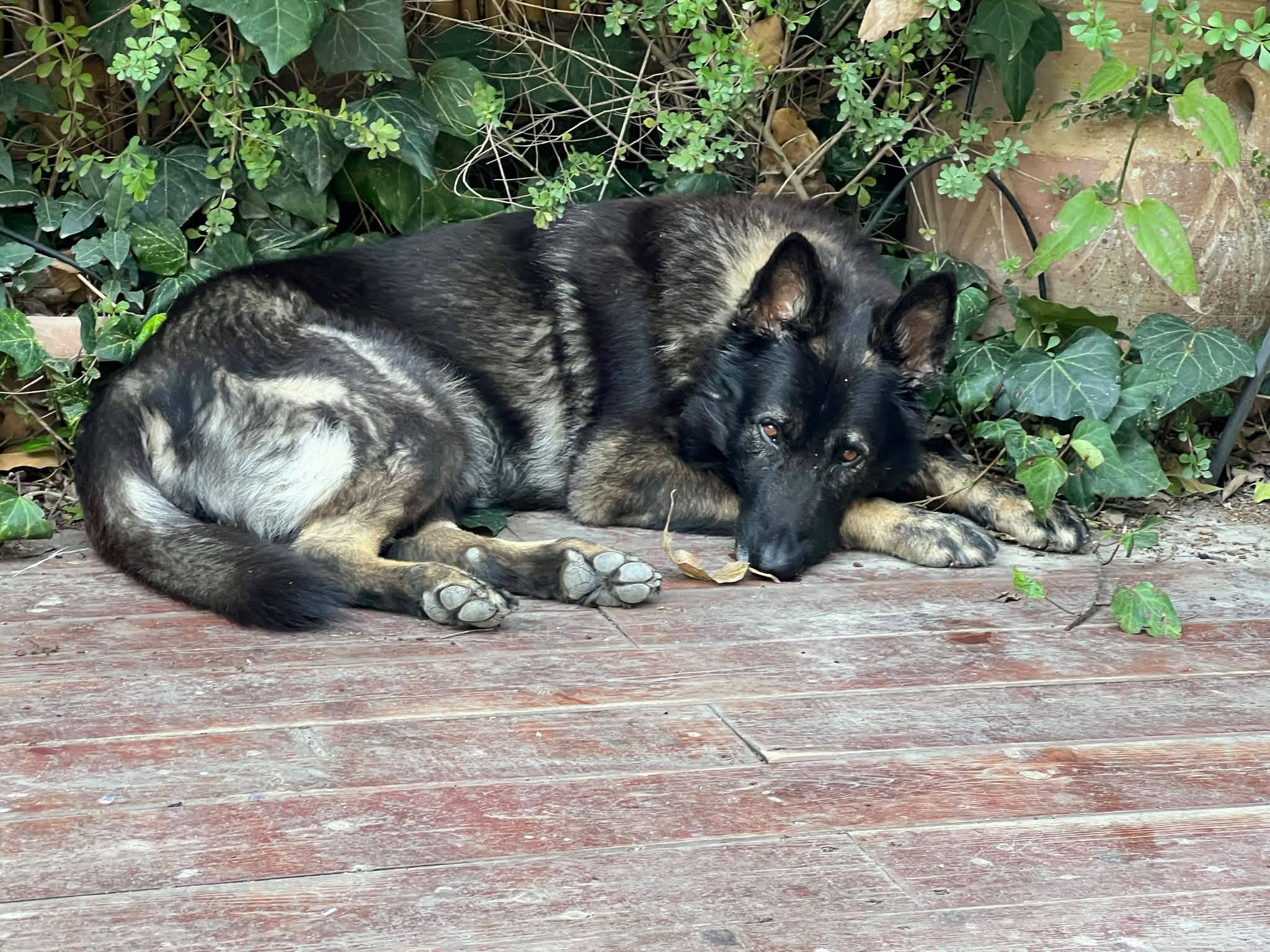
“Dark sable” describes a German Shepherd’s coat appearance. It is not a separate breed.
Echo was a dark sable German Shepherd, and his colouring is one of the details people notice in his photographs. To understand that look, it helps to separate three things: breed, breeding background and coat pattern.
German Shepherd describes his breed. Working line describes his breeding background. Dark sable describes his coat.
What creates the sable appearance?
The pattern commonly called sable in German Shepherds involves hairs with different bands of pigment, creating a layered appearance rather than one uniform block of colour.
Genetic terminology is more precise than everyday coat descriptions. UC Davis describes the agouti pattern as banded hairs containing yellow and black pigment and explains how genes influence pigment distribution. Read the Veterinary Genetics Laboratory’s explanation.
“Dark sable” is a visual description of a darker overall appearance. It should not be treated as a genetic test result.
How is sable different from black and tan?
A familiar black and tan German Shepherd often has a recognisable dark saddle over a lighter body. A sable coat has a more blended appearance across areas of the coat.
A solid black coat is another appearance again.
These distinctions can help you describe what you see. They are less useful for drawing conclusions from a single photograph, particularly when the lighting, angle or image processing changes the way the coat looks.
The German Shepherd Dog Club of America’s breed standard recognises that German Shepherds vary in colour.
Does a darker coat mean a stronger or more protective dog?
Coat colour is not an assessment of behaviour, training or suitability for a home.
If you are choosing a dog, ask about the individual. How does the dog respond to unfamiliar situations? What support and training have they had? What is known about their health and daily needs?
Those questions are more useful than choosing the darkest puppy in a photograph.
The same applies to claims that a colour makes a dog an automatic police prospect. Working suitability requires information a coat cannot provide.
A better way to look at Echo’s photographs
Enjoy the details: the dark colouring, the expression, the shape of his face.
Then remember that a photograph captures only a moment.
Echo also had a history as a police dog, an illness that changed his life and a bond with the person who adopted him. His appearance may be what first catches your attention. His story offers a reason to stay.
Keep Exploring
Related reading:
Stay Close to the Story
Get new stories, guides and MyEcho launch updates by email.
By signing up, you acknowledge the Privacy Policy and agree to the Terms.